
The promise of "next-generation" geothermal was once framed as the "holy grail" of the energy transition: clean, firm, baseload power that could be deployed almost anywhere, bypassing the geographic lottery of traditional volcanic hydrothermal resources. Eavor, a Canadian-based geothermal pioneer, stood at the vanguard of this movement. With a high-profile project in Geretsried, Bavaria, the company sought to move beyond the experimental phase and into the realm of standardized, scalable energy manufacturing.
However, a recent, candid interview in GeoExPro—a publication renowned for its rigorous, subsurface-focused engineering analysis—has shifted the conversation from optimistic anticipation to a sobering audit. The Geretsried project, intended to be the definitive "proof of concept" for Eavor’s closed-loop, multilateral radiator technology, is no longer looking like a triumph of engineering. Instead, it is increasingly viewed as a cautionary tale of the gap between a compelling pitch deck and the stubborn realities of the Earth’s crust.
The Promise vs. The Physical Reality
Eavor’s value proposition was elegant in its simplicity: create a closed, sealed, subsurface radiator. By drilling multilateral loops deep underground, the company aimed to circulate a working fluid that would extract heat via conduction, avoiding the messy, corrosive, and unpredictable brine-handling issues associated with conventional geothermal. It was sold as a "manufactured" energy asset—predictable, low-risk, and repeatable.
The Geretsried project was the stage for this performance. Backed by a robust financing stack—including a €91.6 million EU Innovation Fund grant, a €44–45 million EIB loan, and significant private backing from lenders like ING and Mizuho—the project reached a headline funding total of approximately €368 million. This was not a benchtop prototype; it was a commercial-scale reference plant intended to signal to the global energy market that Eavor’s technology was ready for prime time.
A Chronology of Construction Challenges
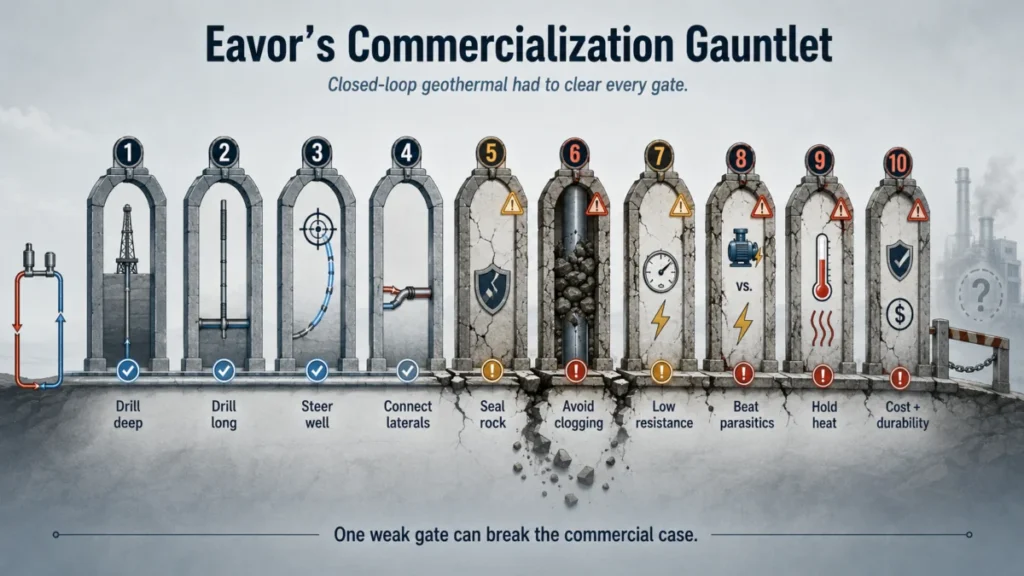
The original design for Geretsried called for four injector-producer well pairs, each featuring complex underground loops. To date, only one of these pairs has been completed. Within this single pair, the results have been underwhelming:

- Completion Shortfalls: Of the planned twelve horizontal loops, only six were completed. Of those, only three to four are contributing materially to heat transfer.
- Mechanical Obstructions: Two of the loops were rendered useless by rock fragments—clogging that could not be cleared—while others appear to contribute only partially to the thermal exchange.
- Performance Gap: The facility was projected to produce between 60 MW and 64 MW of thermal output, resulting in roughly 8 MW of electricity. Current reporting indicates a gross electrical output of only 0.5 MW to 1 MW. After accounting for parasitic load (the energy required to run the pumps), the system is effectively hovering at a net-zero contribution.
For a project of this magnitude, these figures do not represent mere "teething issues." They represent an order-of-magnitude failure to meet design specifications, raising fundamental questions about the viability of the closed-loop architecture at scale.
Supporting Data and the "Rock-Pipe" Moat
Central to Eavor’s proprietary claims is "Rock-Pipe," a technique for sealing wellbores in the open-hole environment without the prohibitive costs of full-length casing. In theory, this is the company’s "crown jewel." If Eavor could prove that they can reliably seal kilometres of horizontal lateral wellbores, they would possess a genuine engineering advantage.
However, a technological moat requires more than just a patent; it requires a defensible, repeatable process. The subsurface is an unforgiving environment characterized by intense mechanical stress, high temperatures, and chemical reactivity. Industry experts note that while sealing chemistry is a legitimate field of study, it is not an empty one. Oil and gas companies have spent decades perfecting fluid-loss management, grouting, and permeability control.
If Rock-Pipe were the revolutionary barrier to entry Eavor claims it is, the evidence would be visible in the Geretsried output. Instead, the evidence suggests that the method currently lacks the consistency required for commercialization. The "moat" appears to be more a matter of proprietary aspiration than a demonstrated, insurmountable barrier to competitors.
Strategic Pivot: From Operator to Technology Provider
The most significant development is not the underperformance of the plant, but the company’s strategic pivot. Eavor is moving away from the role of developer and operator, rebranding itself as a technology provider.

In the corporate world, this is often described as "maturing" or "focusing on intellectual property." In practice, for a project like Geretsried, this signals an exit from the most high-risk aspects of the venture: the drilling, the completion, and the long-term operational responsibility. If a technology provider "licenses" its design but is not responsible for the physical reality of the subsurface, who bears the risk of a clogged loop or a low-performing well?
The transition implies that Eavor is stepping away from the "hard bits"—the very tasks that define whether the technology actually works. By moving into a licensing model, the company is attempting to shift the burden of proof to third-party developers, yet those developers are unlikely to accept such risks without heavy discounts or ironclad guarantees—neither of which Eavor seems positioned to provide.
Implications for Investors and Future Projects
The current situation creates a "buyer’s problem." A sophisticated geothermal developer or an oil and gas major looking to diversify will look at Geretsried and see a distressed asset rather than a turnkey solution.
The Negotiating Hand
Using the framework of Negotiation Genius by Deepak Malhotra and Max Bazerman, we can analyze the position of strategic investors like Chubu Electric, a key backer of Eavor. Chubu’s "Best Alternative to a Negotiated Agreement" (BATNA) is strong. They do not need to buy Eavor’s licensing package to access geothermal energy. They can observe the failures at Geretsried, learn from the data, and partner with traditional drilling and engineering firms to apply better-vetted techniques.
If Eavor pushes for a high upfront licensing fee, potential buyers will rightfully ask: "What am I paying for?"

- The Technology: Is it the thermosiphon? That is physics, not proprietary software.
- The Equipment: Standard ORC and heat pumps are commoditized.
- The Experience: The "scar tissue" of failure is valuable, but it is not a bankable product.
The Contingent Contract Solution
If Eavor truly believes in its technology, it should adopt a performance-based contract structure. Rather than seeking large, non-refundable licensing fees, the company could tie its compensation to verified milestones: sustained net power generation, reliable thermal output, and successful loop completion. If the company refuses such a structure, it sends a clear signal to the market regarding its own confidence in the technology’s performance.
Conclusion: The Path Forward
The dream of next-gen geothermal remains vital. The world desperately needs firm, clean power, and the subsurface is an underutilized battery. However, the Eavor saga serves as a reminder that the subsurface is not a software platform that can be "patched" with a firmware update.
To regain its standing, Eavor must demonstrate three things:
- Repeatability: Showing that a loop can be drilled and sealed successfully without clogging.
- Economics: Demonstrating that the cost of drilling and maintaining these loops is lower than the value of the heat they produce.
- Performance: Delivering the promised electrical output on a sustained, multi-season basis.
Until these metrics are met, Eavor’s transition to a "technology provider" looks less like a strategic evolution and more like a tactical retreat. The company may survive as an IP boutique for a time, but its claim to have "solved" geothermal remains unproven. For the investors and public agencies involved, the Geretsried project has become a lesson in the high cost of pioneering—a reminder that in the energy transition, the most expensive mistake is mistaking a prototype for a product.