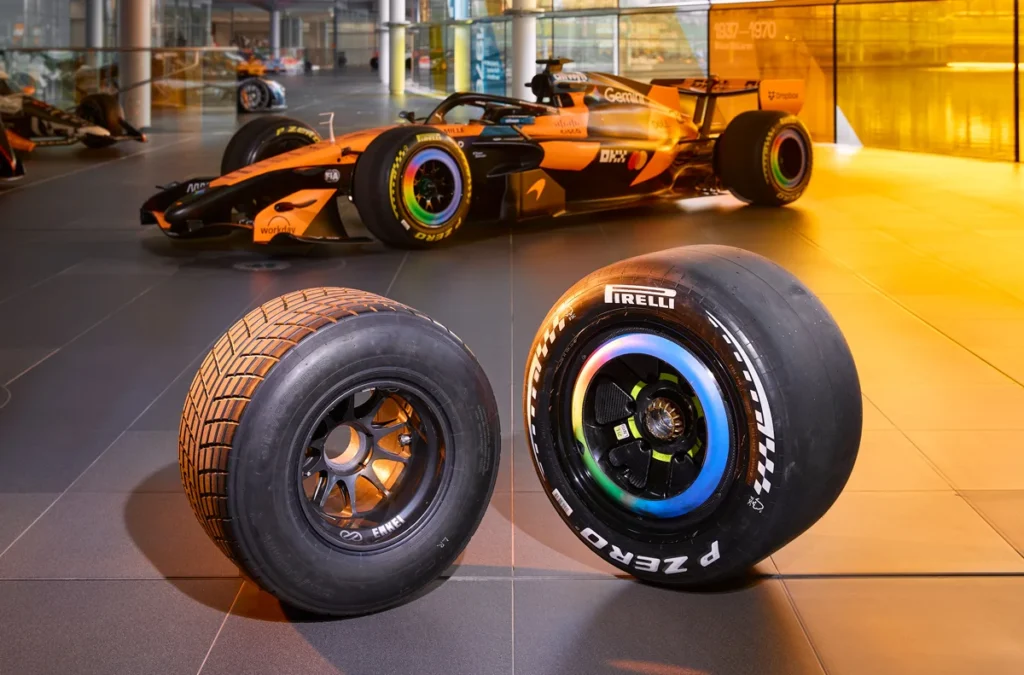

The landscape of Formula 1 is defined by the relentless pursuit of perfection. In a sport where victory is measured in thousandths of a second, the synergy between a chassis and the track—mediated entirely by the wheel—is critical. Today, McLaren Racing and Enkei Corporation have officially announced the renewal of a legendary partnership, confirming Enkei as an Official Supplier for the McLaren Mastercard Formula 1 Team for the 2026 season.
This reunion marks the restoration of one of the most successful technical collaborations in modern motorsport history, bridging a gap created by the sport’s regulatory shift toward standardized wheel components and signaling a new era of bespoke, high-performance engineering.
A Legacy of Precision: The Chronology of Collaboration
To understand the magnitude of this reunion, one must look at the foundation built over a quarter-century of joint effort. The partnership between McLaren and Enkei is not merely a commercial agreement; it is a storied alliance that began in 1995.
The Foundation (1995–2000)
When Enkei first stepped into the McLaren fold in the mid-90s, the goal was simple: to create a wheel that could withstand the brutal torque of the Mercedes-Ilmor engines while shedding critical unsprung mass. Throughout the late 90s, the partnership contributed to iconic machinery, setting the tone for what would become a 26-year tenure of technical excellence.
The Peak Years (2001–2015)
As Formula 1 entered the V10 and early V8 eras, the demands on wheel durability and heat dissipation grew exponentially. During this period, Enkei’s magnesium casting and forging techniques became synonymous with McLaren’s pursuit of aerodynamics. The partnership survived several regulation overhauls, providing the team with lightweight, rigid wheelsets that allowed McLaren’s engineers to fine-tune suspension geometry with greater freedom.
The Regulatory Hiatus (2021–2025)
The introduction of mandatory, standardized wheel specifications by the FIA in recent years forced a temporary pause in the collaboration. While the technical partnership was sidelined due to regulatory constraints, the relationship between the two organizations remained robust, characterized by mutual respect and a shared philosophy of "driven engineering."
The 2026 Renaissance
With the FIA’s 2026 regulatory framework opening new avenues for component design and performance optimization, the timing for a reunion was perfect. Both parties identified that the new technical regulations provided the ideal environment to leverage Enkei’s latest breakthroughs in forged magnesium alloy science.

Technical Specifications: The Science of the Wheel
In the modern Formula 1 era, the wheel is far more than a structural component; it is an aerodynamic device and a thermal regulator. Enkei’s return to the McLaren fold focuses on three primary pillars of performance: weight reduction, structural rigidity, and thermal management.
Advanced Forged Magnesium Technology
The 2026 McLaren MCL40 will feature custom-engineered forged magnesium wheels. Unlike traditional aluminum alloys, magnesium offers a superior strength-to-weight ratio. Forged magnesium is particularly prized because the forging process aligns the metal’s grain structure, resulting in a component that is significantly stronger and more resistant to fatigue than cast equivalents.
Managing Unsprung Mass
In racing, unsprung mass—the components not supported by the suspension—is the enemy of handling. By utilizing Enkei’s specialized forging technology, McLaren engineers have been able to reduce the rotational inertia of the wheel assembly. This reduction allows for:
- Quicker Acceleration: Less energy is required to rotate the wheel assembly.
- Enhanced Braking Efficiency: Reduced weight translates to less strain on the carbon-ceramic brake systems.
- Superior Tire Contact: Improved wheel stiffness ensures that the tire footprint remains consistent through high-speed cornering, minimizing the "flex" that can lead to energy loss and tire degradation.
Thermal Resilience
The 2026 cars will place unprecedented demands on the tires. Enkei’s proprietary alloy compositions are designed to manage heat transfer from the brake discs to the tire bead, ensuring that the tires remain within their optimal operating window for longer stints. This is critical for both qualifying performance and long-run race pace.
Official Perspectives: Leadership Voices
The announcement was met with enthusiasm from the leadership teams at both Woking and Hamamatsu.
Neil Houldey, Executive Director, Technical Director, Applied Engineering, McLaren Racing:
"We are delighted to welcome Enkei back to the McLaren Mastercard Formula 1 Team. Their history of technical excellence in motorsport and focus on high performance will play an important role in taking the MCL40 to the track this season. Using Enkei products is a technically driven collaboration designed to extract every possible performance advantage with a focus on continuous improvement and technological advances. We look forward to working closely with Enkei throughout this exciting partnership."
Makato Miura, President, Enkei Corporation:
"The 26-year journey we shared with the McLaren Mastercard Formula 1 Team from 1995 to 2021 remains an invaluable chapter in Enkei’s history. We are profoundly honored to return as an Official Supplier, once again demonstrating the true caliber of Enkei Wheels on the world’s premier racing stage. As we look toward an even more brilliant future, Enkei is proud to take this next step forward alongside the McLaren Mastercard Formula 1 Team."

Implications for the 2026 Season and Beyond
The return of Enkei to McLaren carries significant implications for the competitive hierarchy of the 2026 grid.
A Competitive Edge
By returning to an bespoke wheel supplier, McLaren is signaling its intent to move away from "off-the-shelf" components where regulations permit. The ability to iterate the wheel design throughout the season—tailoring stiffness profiles for specific circuits like Monaco (low speed, high agility) versus Monza (high speed, extreme braking)—gives McLaren a tactical advantage that teams relying on standardized, one-size-fits-all hardware may lack.
Sustainability and Innovation
Enkei’s commitment to sustainable manufacturing processes, including the recycling of magnesium alloys, aligns with McLaren’s broader sustainability goals. The collaborative R&D loop established between the two companies will likely result in "trickle-down" technology, where advancements made for the F1 circuit find their way into Enkei’s high-performance road wheels, benefiting enthusiasts globally.
The "MCL40" Development Cycle
As the team prepares the MCL40 for its debut, the integration of Enkei’s hardware is being fast-tracked through wind tunnel testing and CFD (Computational Fluid Dynamics) simulations. The wheel’s interaction with the air—specifically the wake created by the rotating wheel—is a major focus for aerodynamicists. The precision of Enkei’s manufacturing ensures that the aerodynamic data gathered in the virtual world remains perfectly accurate in the real world.
Conclusion: A Future Forged in Magnesium
The partnership between McLaren Racing and Enkei is a testament to the fact that, in Formula 1, relationships are as important as the physics themselves. The institutional knowledge shared between these two giants—spanning over two decades—creates a unique shorthand in communication and development that cannot be replicated.
As the 2026 season approaches, all eyes will be on the McLaren MCL40. Beyond the livery and the driver lineup, the technical underpinnings of the car will feature the hallmark of a true racing partnership: wheels that are not just components, but pieces of precision engineering designed to push the boundaries of what is possible on four wheels.
For the fans of McLaren and the engineering community at large, this reunion is more than a supply contract; it is the return of a championship-winning formula that promises to make the upcoming season one of the most technically fascinating in recent memory.